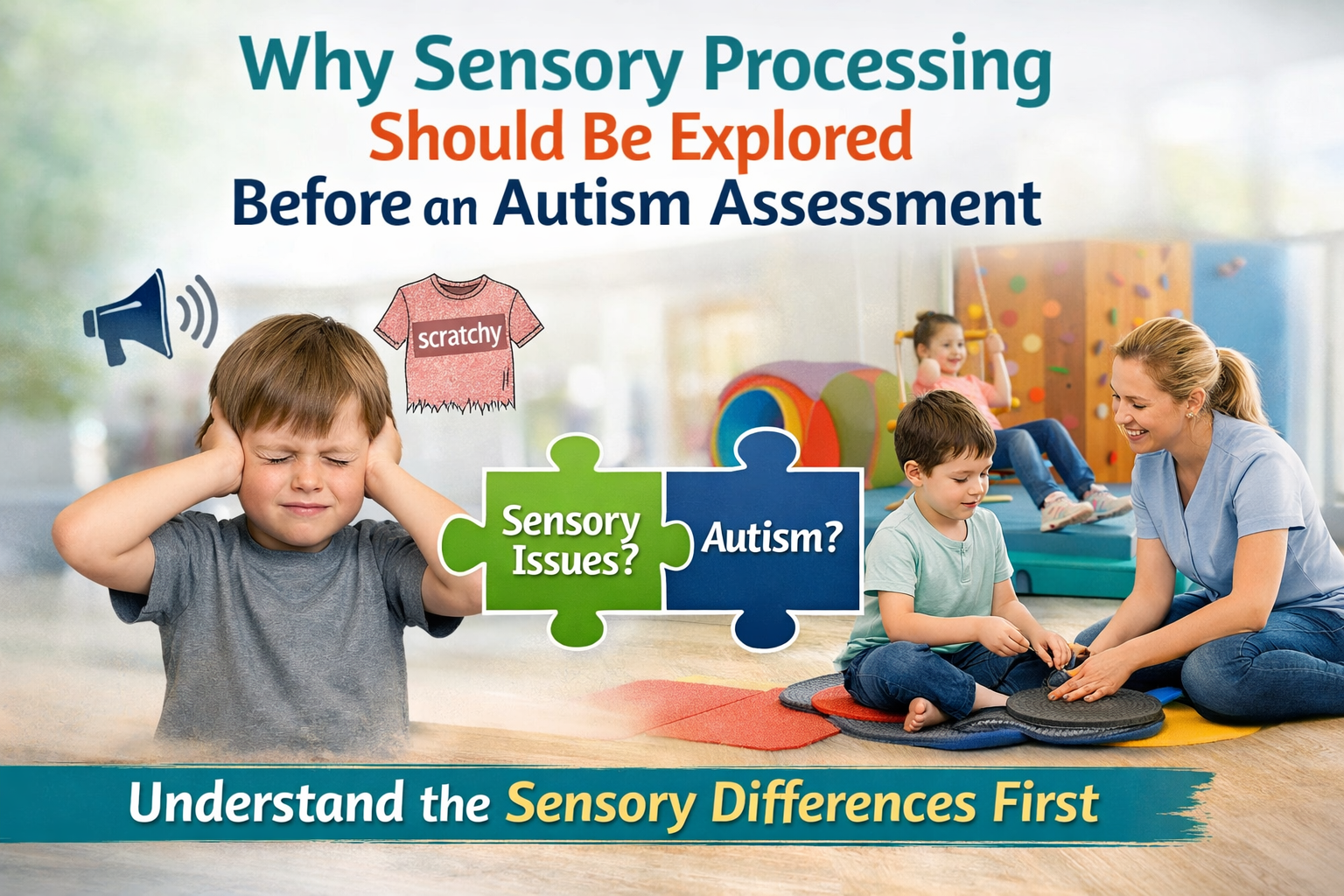


As awareness of Autism Spectrum Disorder (ASD) continues to grow, more parents and schools are becoming alert to early signs of developmental differences. This is a positive step—but it can also lead to understandable concern and, at times, premature conclusions.
One of the most important (and often overlooked) factors in this process is Sensory Processing.
The Overlap Between ASD and Sensory Processing
It is widely recognised that the vast majority of children with ASD experience difficulties with sensory processing. These may include:
– Sensitivity to noise, touch, or movement
– Avoidance of certain textures or environments
– Seeking intense sensory input (e.g. crashing, spinning)
– Difficulty with attention, regulation, or transitions
In clinical practice, this is often referred to as Sensory Processing Disorder (SPD) or sensory integration difficulties.
However, the reverse is not always true:
Not all children with sensory processing challenges have Autism.
Many children present with sensory-based difficulties that impact behaviour, emotional regulation, motor development, and attention—but do not meet the criteria for ASD.
Why This Matters for Assessment and Diagnosis
When sensory processing differences are not identified early, they can sometimes be mistaken for signs of autism.
Without understanding the underlying sensory drivers, it can be difficult to form an accurate picture of a child’s needs.
Why Occupational Therapy Should Be the First Step
Occupational Therapists (OTs), particularly those trained in Sensory Integration (SI), are uniquely positioned to assess how a child processes and responds to sensory information.
An SI-informed assessment can help to:
– Identify specific sensory processing challenges
– Understand how these impact behaviour and daily functioning
– Provide targeted strategies and intervention
– Support regulation, attention, and engagement
A Clearer Picture Before Diagnosis
This does not mean avoiding or delaying an autism assessment where appropriate.
Rather, it ensures sensory processing differences are understood and supported first—so that any further assessment is based on a clearer, more accurate picture of the child.
Supporting Your Child in the Right Way
Every child is different, and there is no one-size-fits-all pathway.
At Kids in Sync South West, we specialise in sensory integration assessments, individualised therapy programmes, and working closely with families and schools.
Our goal is always to understand the “why” behind a child’s behaviour.
Final Thoughts
If your child is showing signs that concern you, it’s natural to want answers quickly.
But sometimes, the most helpful first step is not a label—it’s understanding.
Call to Action
If you would like to explore your child’s sensory processing and development, get in touch with our team to discuss an assessment.